Worksheet5 files · Assess
AI readiness scorecard
A scoring worksheet for deciding whether a workflow is ready for autonomous or semi-autonomous execution.
baciu.com 服务领域
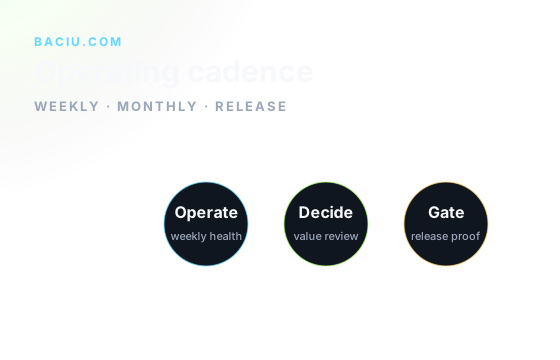
A cross-functional operating cadence for weekly AI service reviews, monthly value decisions, release gates, and escalation ownership.
主题扩展
A scoring worksheet for deciding whether a workflow is ready for autonomous or semi-autonomous execution.
查看页面A control matrix that maps AI capability scope to data access, tool authority, approvals, logging, and incident response.
查看页面A starter evaluation set for testing source grounding, citation behavior, permission boundaries, and answer quality.
查看页面A production runbook for model routing, fallback, cost controls, latency, tracing, degraded mode, and release review.
查看页面A board-ready outline for connecting AI initiatives to outcomes, risk gates, build sequence, and decision cadence.
查看页面A tabletop exercise for AI services that can produce wrong answers, unsafe actions, policy violations, or outage cascades.
查看页面A practical operating model for assigning ownership across AI product, platform, risk, operations, and business teams.
查看页面A structured intake template for deciding whether a process should become an assistant workflow, agent workflow, or deterministic automation.
查看页面Use these files as the starting point for a workshop, operating review, or delivery handoff.
A cross-functional cadence pack for weekly AI operating reviews, monthly value reviews, decision logs, and escalation ownership.
Cadence calendarCSV calendarWeekly, monthly, quarterly, and release-driven operating rituals mapped to attendees, evidence, decisions, and outputs.
Decision logCSV logDecision-register rows for scale, tune, hold, rollback, funding, risk acceptance, and operating-owner assignment.
Ritual modelJSON modelStructured ritual definitions for operating reviews, value reviews, incident reviews, release gates, and adoption checks.
Review agendaReview agendaFacilitation agenda for running a disciplined AI operating review across product, platform, operations, risk, and finance.
Owner briefOwner briefBriefing template for accountable owners covering signals, decisions needed, tradeoffs, evidence, and follow-up commitments.
Escalation mapEscalation mapEscalation ownership model for quality, cost, latency, adoption, compliance, and customer-impact thresholds.
Resource library
Use these outlines as starting points for assessments, runbooks, governance reviews, and executive planning.
A scoring worksheet for deciding whether a workflow is ready for autonomous or semi-autonomous execution.
A control matrix that maps AI capability scope to data access, tool authority, approvals, logging, and incident response.
A starter evaluation set for testing source grounding, citation behavior, permission boundaries, and answer quality.
交付图谱
筛选、对比并直达 AI 架构、执行与治理的详细页面。
实施库
An enablement kit for driving trusted AI adoption through training, champion networks, feedback loops, and behavior metrics.
A finance model for attributing AI runtime cost by workflow, department, customer segment, provider, and outcome.
A communications plan for AI incidents covering internal escalation, customer updates, regulatory notice, and postmortems.
A practical operating model for assigning ownership across AI product, platform, risk, operations, and business teams.
A release governance kit for managing prompt, model, policy, retrieval, and tool-authority changes in agentic systems.
A data-boundary kit for preventing sensitive data leakage across prompts, retrieval, logs, model providers, tools, and exports.
A review outline for documenting AI data handling, retention, subprocessors, residency, and customer control requirements.
A benchmark pack for measuring AI value across baseline cost, adoption, unit economics, and value-review decisions.
A control kit for managing AI value through adoption curves, unit economics, operating cost, quality signals, and scale decisions.
An incident communications kit for AI failures covering internal escalation, customer messaging, regulatory notice, and postmortem evidence.
A tabletop exercise for AI services that can produce wrong answers, unsafe actions, policy violations, or outage cascades.
A portfolio prioritization kit for ranking AI opportunities by value, feasibility, risk, operating readiness, and learning leverage.
A scoring worksheet for deciding whether a workflow is ready for autonomous or semi-autonomous execution.
A service-level objective template for AI latency, quality, cost, availability, escalation, and degraded-mode behavior.
A rollout runbook for moving AI-assisted workflows from pilot to controlled scale with queue gates, training, controls, and adoption metrics.
A risk register for tracking AI authority, reversibility, sensitive data exposure, failure modes, mitigations, and owners.
A dashboard outline for monitoring provider mix, cost drift, latency budgets, fallback rates, and quality regressions.
An operations kit for AI-assisted support queues covering triage policy, containment metrics, escalation, QA, and customer communications.
A source inventory for mapping owners, freshness, permissions, quality issues, retention rules, and ingestion priority.
A regression suite for AI releases covering task quality, source grounding, safety, tool behavior, latency, and cost movement.
A release-gate template that connects evaluation results, known regressions, approval decisions, rollback, and launch notes.
A board-ready outline for connecting AI initiatives to outcomes, risk gates, build sequence, and decision cadence.
A steering-committee packet for connecting AI portfolio decisions to milestones, risks, spend, and operating outcomes.
A finance operations kit for AI-assisted reconciliation, variance explanation, close controls, reviewer evidence, and audit-ready reporting.
A model risk operations kit for financial services AI systems covering evidence, approvals, monitoring, controls, and audit readiness.
A control matrix that maps AI capability scope to data access, tool authority, approvals, logging, and incident response.
A healthcare AI safety intake kit for triaging clinical-adjacent workflow ideas before pilot, procurement, or production rollout.
A policy template for defining which AI decisions require approval, who approves them, and what evidence is required.
A claims operations kit for using AI across intake, coverage evidence, adjuster review, leakage monitoring, and customer communications with explicit controls.
A logistics operations kit for detecting shipment, inventory, carrier, supplier, and customer-commitment exceptions with evidence-backed recovery paths.
A manufacturing AI kit for connecting quality signals, maintenance notes, production exceptions, and operator feedback into governed intelligence loops.
A context-governance kit for deciding what AI systems may remember, retrieve, personalize, retain, forget, and expose to users.
A decision tree for routing between models, cached answers, degraded mode, escalation, and temporary shutdown.
A telemetry kit for model-backed services covering request traces, quality signals, cost, latency, fallback, and incident triggers.
An operating kit for model routing, runtime incident triage, provider fallback drills, release gates, and remediation ownership.
A production runbook for model routing, fallback, cost controls, latency, tracing, degraded mode, and release review.
能力雷达
选择运营视角和时间跨度,查看相关路径、信号和决策页面。
执行蓝图
每个领域都通过明确的定义、可度量的验证和可交接给客户团队的运营治理来交付。
运营检查清单
A clear system map covering models, tools, data, workflows, users, and failure modes.
查看页面Task sets, regression checks, and release criteria for measurable AI behavior.
查看页面Human approval, access, logging, data-boundary, and incident-response rules.
查看页面Documentation and ownership so the client can operate the system after launch.
查看页面覆盖地图
A scoring worksheet for deciding whether a workflow is ready for autonomous or semi-autonomous execution.
查看页面A control matrix that maps AI capability scope to data access, tool authority, approvals, logging, and incident response.
查看页面A starter evaluation set for testing source grounding, citation behavior, permission boundaries, and answer quality.
查看页面A production runbook for model routing, fallback, cost controls, latency, tracing, degraded mode, and release review.
查看页面相关页面
Downloadable implementation outlines for teams planning, evaluating, governing, and operating production AI systems.
查看页面A scoring worksheet for deciding whether a workflow is ready for autonomous or semi-autonomous execution.
查看页面A control matrix that maps AI capability scope to data access, tool authority, approvals, logging, and incident response.
查看页面