Matrix5 files · Govern
Governance control matrix
A control matrix that maps AI capability scope to data access, tool authority, approvals, logging, and incident response.
Obszar usług baciu.com
A scoring worksheet for deciding whether a workflow is ready for autonomous or semi-autonomous execution.
Zaczynamy od procesu, użytkowników i ryzyk, potem wybieramy najmniejszą mierzalną architekturę.
Otwórz stronęDobry system zachowuje źródła, ewaluacje, telemetrię i reguły eskalacji.
Otwórz stronęRozszerzenie tematu
A control matrix that maps AI capability scope to data access, tool authority, approvals, logging, and incident response.
Otwórz stronęA starter evaluation set for testing source grounding, citation behavior, permission boundaries, and answer quality.
Otwórz stronęA production runbook for model routing, fallback, cost controls, latency, tracing, degraded mode, and release review.
Otwórz stronęA board-ready outline for connecting AI initiatives to outcomes, risk gates, build sequence, and decision cadence.
Otwórz stronęA tabletop exercise for AI services that can produce wrong answers, unsafe actions, policy violations, or outage cascades.
Otwórz stronęA practical operating model for assigning ownership across AI product, platform, risk, operations, and business teams.
Otwórz stronęA structured intake template for deciding whether a process should become an assistant workflow, agent workflow, or deterministic automation.
Otwórz stronęA risk register for tracking AI authority, reversibility, sensitive data exposure, failure modes, mitigations, and owners.
Otwórz stronęUse these files as the starting point for a workshop, operating review, or delivery handoff.
A practical scoring sheet for deciding whether a workflow is ready for agentic execution.
Scoring workbookCSV workbookWeighted scoring rows for value, risk, data quality, controls, and operating readiness.
Evidence modelJSON modelStructured evidence fields for intake systems, stakeholder review, and readiness gates.
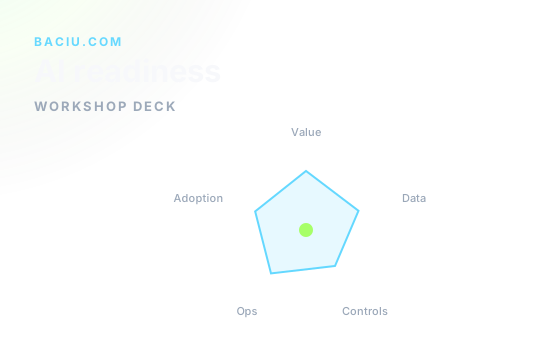
Workshop deckWorkshop deckEditable facilitation deck for scoring workflow readiness with sponsors, data owners, risk, and operations.
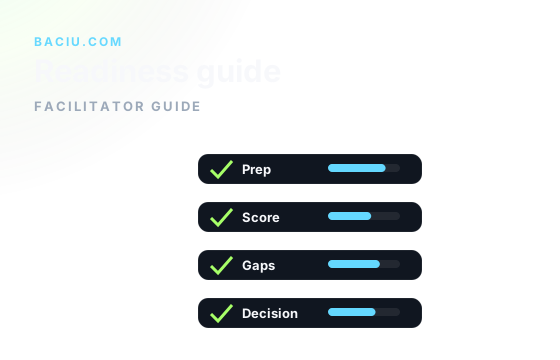
Workshop guideFacilitator guideClient-ready workshop guide for preparation, scoring discussion, evidence gaps, and readiness decisions.
Resource library
Use these outlines as starting points for assessments, runbooks, governance reviews, and executive planning.
A control matrix that maps AI capability scope to data access, tool authority, approvals, logging, and incident response.
A starter evaluation set for testing source grounding, citation behavior, permission boundaries, and answer quality.
A production runbook for model routing, fallback, cost controls, latency, tracing, degraded mode, and release review.
Atlas wdrożeń
Filtruj, porównuj i przechodź do szczegółowych stron o architekturze, realizacji i nadzorze AI.
Biblioteka wdrożeniowa
An enablement kit for driving trusted AI adoption through training, champion networks, feedback loops, and behavior metrics.
A finance model for attributing AI runtime cost by workflow, department, customer segment, provider, and outcome.
A communications plan for AI incidents covering internal escalation, customer updates, regulatory notice, and postmortems.
A practical operating model for assigning ownership across AI product, platform, risk, operations, and business teams.
A release governance kit for managing prompt, model, policy, retrieval, and tool-authority changes in agentic systems.
A data-boundary kit for preventing sensitive data leakage across prompts, retrieval, logs, model providers, tools, and exports.
A review outline for documenting AI data handling, retention, subprocessors, residency, and customer control requirements.
A benchmark pack for measuring AI value across baseline cost, adoption, unit economics, and value-review decisions.
A control kit for managing AI value through adoption curves, unit economics, operating cost, quality signals, and scale decisions.
An incident communications kit for AI failures covering internal escalation, customer messaging, regulatory notice, and postmortem evidence.
A tabletop exercise for AI services that can produce wrong answers, unsafe actions, policy violations, or outage cascades.
A cross-functional operating cadence for weekly AI service reviews, monthly value decisions, release gates, and escalation ownership.
A portfolio prioritization kit for ranking AI opportunities by value, feasibility, risk, operating readiness, and learning leverage.
A service-level objective template for AI latency, quality, cost, availability, escalation, and degraded-mode behavior.
A rollout runbook for moving AI-assisted workflows from pilot to controlled scale with queue gates, training, controls, and adoption metrics.
A risk register for tracking AI authority, reversibility, sensitive data exposure, failure modes, mitigations, and owners.
A dashboard outline for monitoring provider mix, cost drift, latency budgets, fallback rates, and quality regressions.
An operations kit for AI-assisted support queues covering triage policy, containment metrics, escalation, QA, and customer communications.
A source inventory for mapping owners, freshness, permissions, quality issues, retention rules, and ingestion priority.
A regression suite for AI releases covering task quality, source grounding, safety, tool behavior, latency, and cost movement.
A release-gate template that connects evaluation results, known regressions, approval decisions, rollback, and launch notes.
A board-ready outline for connecting AI initiatives to outcomes, risk gates, build sequence, and decision cadence.
A steering-committee packet for connecting AI portfolio decisions to milestones, risks, spend, and operating outcomes.
A finance operations kit for AI-assisted reconciliation, variance explanation, close controls, reviewer evidence, and audit-ready reporting.
A model risk operations kit for financial services AI systems covering evidence, approvals, monitoring, controls, and audit readiness.
A control matrix that maps AI capability scope to data access, tool authority, approvals, logging, and incident response.
A healthcare AI safety intake kit for triaging clinical-adjacent workflow ideas before pilot, procurement, or production rollout.
A policy template for defining which AI decisions require approval, who approves them, and what evidence is required.
A claims operations kit for using AI across intake, coverage evidence, adjuster review, leakage monitoring, and customer communications with explicit controls.
A logistics operations kit for detecting shipment, inventory, carrier, supplier, and customer-commitment exceptions with evidence-backed recovery paths.
A manufacturing AI kit for connecting quality signals, maintenance notes, production exceptions, and operator feedback into governed intelligence loops.
A context-governance kit for deciding what AI systems may remember, retrieve, personalize, retain, forget, and expose to users.
A decision tree for routing between models, cached answers, degraded mode, escalation, and temporary shutdown.
A telemetry kit for model-backed services covering request traces, quality signals, cost, latency, fallback, and incident triggers.
An operating kit for model routing, runtime incident triage, provider fallback drills, release gates, and remediation ownership.
A production runbook for model routing, fallback, cost controls, latency, tracing, degraded mode, and release review.
Laboratorium realizacji
Dostosuj tempo, autonomię i profil ryzyka, aby zobaczyć rekomendowane fazy, zależności i bramki kontrolne.
Rekomendowane fazy
Żadnego wyszukiwania bez dyscypliny źródłowej
Zaufanie jest cechą produktu
Działanie z odpowiedzialnością
Każde wydanie zdobywa zaufanie
Kontroluj, gdzie dzieje się praca
Zespoły klientów mogą działać niezależnie
Radar możliwości
Wybierz perspektywę i horyzont, aby zobaczyć tory działań, sygnały i powiązane strony decyzyjne.
Priorytetowe tory
Adoption managed as an operating system
Otwórz stronęStrategia ze ścieżką realizacji
Otwórz stronęZarządzanie w pętli dostaw
Otwórz stronęDostawa zaprojektowana z myślą o trwałym użytkowaniu
Otwórz stronęKontroluj, gdzie dzieje się praca
Otwórz stronęPlan realizacji
Każdy obszar dostarczamy przez jasną definicję, mierzalną walidację i operacyjny nadzór możliwy do przejęcia przez zespół klienta.
Define explicit goals, boundaries, and stop conditions before implementation.
Otwórz stronęRun iterative plan-execute-verify loops before delivering outcomes.
Otwórz stronęKeep human approval for sensitive or irreversible actions.
Otwórz stronęLista operacyjna
A clear system map covering models, tools, data, workflows, users, and failure modes.
Otwórz stronęTask sets, regression checks, and release criteria for measurable AI behavior.
Otwórz stronęHuman approval, access, logging, data-boundary, and incident-response rules.
Otwórz stronęDocumentation and ownership so the client can operate the system after launch.
Otwórz stronęZacznij od powtarzalnych, odwracalnych przepływów pracy, w których można zmierzyć wyniki i granice niepowodzeń.
Używaj zestawów ewaluacyjnych, scenariuszy kontradyktoryjnych i wyraźnych kryteriów typu „go/no-go” powiązanych z wpływem na biznes.
Z granicami uprawnień, progami zaufania, pakietami eskalacji i pełnymi śladami wykonania.
Traktuj zmiany modelu i podpowiedzi jako wydania: testuj, przeglądaj, zatwierdzaj i wdrażaj ze ścieżkami wycofywania.
Mapa pokrycia
A control matrix that maps AI capability scope to data access, tool authority, approvals, logging, and incident response.
Otwórz stronęA starter evaluation set for testing source grounding, citation behavior, permission boundaries, and answer quality.
Otwórz stronęA production runbook for model routing, fallback, cost controls, latency, tracing, degraded mode, and release review.
Otwórz stronęA board-ready outline for connecting AI initiatives to outcomes, risk gates, build sequence, and decision cadence.
Otwórz stronęPowiązane strony
Downloadable implementation outlines for teams planning, evaluating, governing, and operating production AI systems.
Otwórz stronęA control matrix that maps AI capability scope to data access, tool authority, approvals, logging, and incident response.
Otwórz stronęA starter evaluation set for testing source grounding, citation behavior, permission boundaries, and answer quality.
Otwórz stronę